
to the many flights in life….
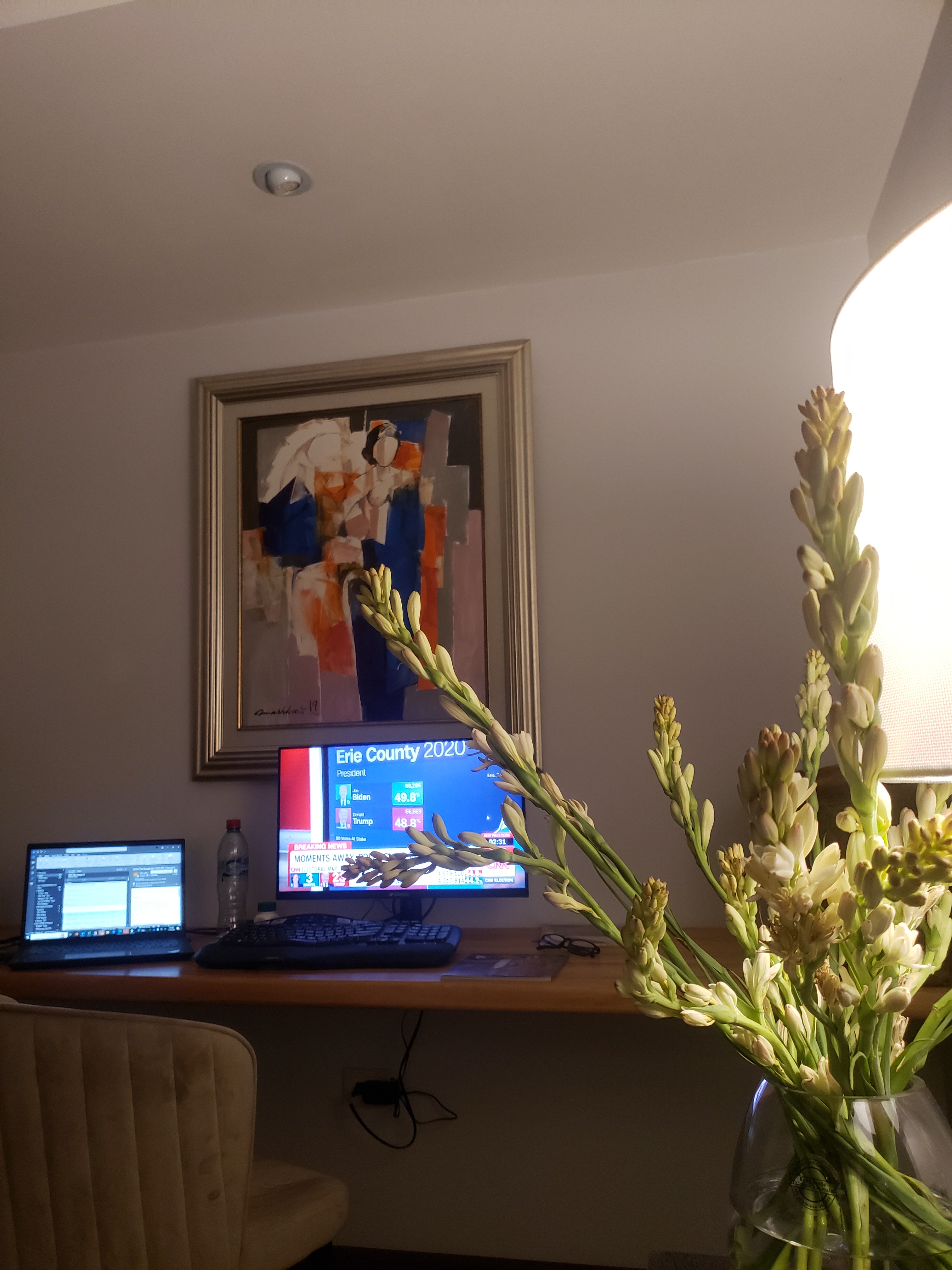
Sitting in Guatemala, closely following live election results on our laptop via VPN. The night feels filled with anxiety, a sense of déjà vu from 2016. Fast forward to the morning, and I wake up to the sounds of chicken buses, birds, street vendors at the local fruit market, and an announcement of Trump’s victory. What follows is a flood of emotions, raising many existential questions—a desperate need to make sense of what seems, to most, like an entirely nonsensical choice.
The optimist in me cannot fully accept that Trump’s victory is a mandate for hate, bigotry, and misogyny (though the latter may be true). Immigrants, Latinos, Muslims, women, all voted for him. I believe his win is less about hatred and more about a vote for simplicity, fear, and ignorance. He offers the masses simple choices in an increasingly complex world. In an era where people consume news from quick soundbites, social media reels, and influencers, there’s little room left for deep analysis or critical thinking. As attention spans dwindle, and complexity rises, fewer people are willing to invest time in research or nuanced understanding. Yes, historically, the masses weren’t reading Aristotle or Plato, but the current climate marks a growing disregard for intellectuals who once distilled complex ideas for the public. The importance of history, critical thinking, and careful research is slipping away. We’re trapped in our own echo chambers of ignorance.
Trump has a unique gift for articulating non-intellectual thoughts. He simplifies complex ideas, policies, ideologies, and laws into single-line (often hate) slogans that resonate with his audience. He promises a return to simpler times, nostalgic to many in a rapidly growing and changing world. His buffet table of hate offers everyone something to fear, someone to blame and feed their deep-rooted insecurities. No longer are people voting fearlessly; they’re voting out of fear—fear of Muslims, immigrants, feminists, gays, China, Zionists, or the unborn fetus. Trump simplifies the world’s problems and presents even more oversimplistic solutions.
Credit where credit is due: in a world where success is measured by social media followers, likes, and TRP ratings, Trump is a star. When a star is born, they can take good causes forward by quantum leaps. The power of celebrity propelled important causes forward, as seen with figures like Gandhi, Mandela, and Nehru. Similarly evil stars are also born, using their celebrity status to propel negativity (fascism, hate, bigotry) but their influence ends with them. Ideologies like Nietzche, RSS, white supremacy have existed long before Hitler, Modi and Trump. But they only gained momentum due to the star factor of these leaders. Just as the Nazi ideology died with Hitler, I believe that after leaders like Trump and Modi, their followers will struggle to carry on their hate-driven legacies in the same way. Many politicians are riding the wave with Trump but on their own can still not carry this message of hate forward. A good example being Ron De Santis, or Advani in India. These are opportunists who survive on a parasitic relationship to the host but will flip or wither away when the star dies.
Just as this election seals Trump’s victory, it also finally marks his end, NOV 2028. Just as a star is born……a star also dies.

Wow what a year it has been. As we celebrated the arrival of 2020, no one could have imagined what it would entail, what surprises it held within it and how it would change lives. As 2020 comes to an end, we (well I should correct myself, many of us) have gotten used to some of the new norms, the masks, the social distancing. But no matter which category we fall under, the believers or disbelievers, the mask wearers or rule breakers, the rich or poor, the young or elderly, 2020 would have changed our lives in some way or the other. It made it obvious how interconnected our lives are even though we might choose to believe we belong to a small self selected world, independent of others. The Covid pandemic not only shattered that myth but made it blatantly clear how not just our present but our future is also interdependent. As we self isolated to fight the pandemic in our small bubbles limiting ties and connections, the chords we share with the rest of the world and humanity had invisibly grown. The stakes we share with the whole world have never been greater.
The virus for the most part was non discriminating. It didn’t discriminate on the basis of color, gender, economics, geography or age. Yet even though the virus didn’t discriminate we as human beings tried to find ways to discriminate. But whether you believe in conspiracy theories or science, whether you believe the virus was man made or natural, whether covid was caused by 5G, 3G, 2G or the Big G (God), it has been a year of learning and should have served as a time to reflect. Reflect on what we truly cherish in life. Reflect on the people who really matter in our lives. Discern between our wants and our needs. Discern between our friends and our acquaintances.
The pandemic has been a time for me to do all of the above. It made me realize what I enjoy and cherish. But to my surprise things we think we will miss were really not on the list. I didn’t miss not going out, not shopping, not going to restaurants, not attending parties. The memories, friends, family that I remembered in the pandemic made me realize who, what and where I want to choose to spend my time once the pandemic ends. It gave me a road map for the future, even though ironically it also showed how one event can change all maps and planning.
Our family lost many loved ones this year. Many to covid, some to other causes, but the losses have left a vacuum which will be hard to fill. I wanted to make a list of all the deaths I heard of this year, so I remember what the pandemic meant. It was not a normal year, they were not the regular number of people that die every year, it was not a conspiracy , they were not exaggerated numbers, it happened and it can happen again.
Neeraj Tyagi (Dehradun, India, old family friend)
Shagun Tyagi (Dehradun, India, old family friend)
Roshan Mahfooz (Dehradun, India, old family friend)
Ehsan Anam (Islamabad, Pakistan, friend’s father)
Mohammad Saleem (Dallas TX, a friend’s father in law)
Moin Kirmani (Montreal, Canada, friend’s uncle)
Sidiq Jamal (Karachi, Pakistan, friend’s uncle)
Ijaz Khan (Lahore, Pakistan a friend’s brother in law)
Abdul Hannan Khan ( Lucknow India, my father’s uncle)
Jameel Khalu (Karachi, Pakistan, brother in law’s uncle)
Shehnaz Siddiqi (Florida, USA, family friend’s sister)
Kunwar Farhad Ali Khan (Saharanpur, India, my grandmother’s cousin)
Shahid Muhammad Khan( Lucknow, India, my father’s brother in law)
Tazeen Shahid Khan (Lucknow, India, father’s sister)
Ali Mohamed Afdhal Najeeb (Dubai, UAE, friend’s cousin)
Mohammad Yahya Chabra (Delhi, India, Sister in law’s grandfather)
Hafeez khalu(London, UK, Mother in law’s cousin’s husband)
Wali khalu (Karachi, Pakistan, Mother in law’s cousin’s husband)
Sanjeeda Khatoon( Karachi, Pakistan, my father’s aunt)
Tasneem Masood (Islamabad, Pakistan, friend’s mother)
Rashid Naseer Khan (Islamabad, Pakistan, friend’s uncle)
Salma Khatoon -Allah rakha mami (Lahore, Pakistan, grandmother’s cousin)
Aunt’s best friend (New Jersey)
Rafiyya Mahmood Khan (Karachi, Pakistan, Friend’s mother in law)
Abdullah Ahmed (Meerut, India)
(These are just some of the names I was directly connected to, listed in the order of dates they died, all except 5 were covid related deaths)
Many of these people may have never met, or could not meet due to visa, border, travel restrictions. Yet they were interconnected, they shared a common fate, they all died by the same virus. The virus that killed them was not restricted by geography or demography.
Some of the most memorable moments of 2020 are ones that embody human cooperation, from the world’s oldest democracy holding a fair election during a pandemic, with the largest voter turnout. Countries coming together to produce a covid vaccine. Health workers selflessly working to save lives. Essential workers selflessly working to keep our daily lives uninterrupted. Some of the ugliest moments of 2020 embody human greed, devicivness and selfishness.
Wow, what a year it has been. The lives and loved ones lost, the battles fought , some won and some lost……wow what a year it has been.
I often hear people say that they don’t owe anyone anything, we haven’t taken anyone’s favor (ehsan). Whenever I hear people say that , I immediately wonder how lonely and unloved they must feel.
When people say we have never taken anyone’s ehsan (favor), it tells me a lot about them. How they view favors, only in terms of its monetary value. Their urgency to pay it and get it off the books is a deep desire to equalize. Even though when they took the favor, the inequality was explicit in their minds, not necessarily in the lenders. When you ask someone for something you need , it was at a time when you most needed it. You paid it back at a time when they didn’t need it. Its explicit value may be the same but its implicit value is not.
Any act of kindness towards us is a favor and carries a debt. The debt can be emotional (good deed, kind gesture, support), or financial (loan, monetary help, expenditure). It’s monetary value, is the only liability portion of it, the rest of it is an asset. When we pay back our financial debts it is important to retain the emotional debt of that transaction. When you try to erase it, you have gotten rid of an asset not just a liability.
Just because it didn’t carry a monetary value or in some cases the monetary component was paid back doesn’t mean the debt ended. Only its monetary liability ended, its emotional assets carry forth. One should never forget these debts because they enrich our lives, they connect us through bonds of giving. They remind us that we are loved enough that someone was willing to do something for us and our loved ones. Being loved is an important human need.
Growing up , I always remember my parents repeatedly telling us stories of all the characters in their lives who played a role. I find them even today repeating those stories. My parents will often recall the friend who took them to Saudi Arabia, the friend who helped him get a job, the relatives who stayed with us and enriched our lives by giving us love, the person who helped us get a piece of land or built our house. Childhood stories of uncle and Aunty Sharma, Nomani sahab, Uncle and Aunty Kazmi, Oma……. Endless stories of friends and families and how they did something for them or their loved ones. They could have easily remembered these stories in context of what they did for them or remembered them from the perspective of how they were repayments for things they had done or in many cases recalled them as being paid back or simply as inconveniences. Instead in every story they told us, they chose to focus on what each one gave them rather than what they took from them.
By sharing these stories, they have also tied us in a bond of love with all those people. Some of whom we knew and some we never met. But just knowing so many people gave us so much, is a feeling of being loved. Being cared for. Being cherished. Being remembered.
The only way to repay an emotional debt is to remember it and repay it through emotions. By appreciating and remembering the lender. In doing so, we are not only enriching ourselves but also the lender. When we remember what someone has done for us and remind our children of it , we are not burdening them under the weight of debt rather we are enriching them with the asset of love. We are creating links and ties, connected through the chords and bonds of love, care, concern of those who undertook that lending.
When some one does something for us , it is important to remember that they didn’t do it because it was the best financial decision, but rather because it was the best emotional decision. Its origination fee was emotions and its closing cost need to also be emotions.
Most of the happiest people I know believe there were many people behind them and their success. Some of the unhappiest people believe they are alone, they don’t need anyone, they don’t owe anything. Neither love nor wealth can ever be generated or truly cherished in loneliness but only in togetherness.
I still remember the day our satellite dish was being installed at our home in Riyadh. The excitement, the curiosity, some fear of the unknown, accompanied the commotion surrounding the installation of this massive round circular dish. This magical dish that would open the world to us and for a while seemed to have brought the whole world closer. In my young mind, this was the beginning of a new era. An era where people will share ideas, cultures, freedoms, economies and the planet. Little did I know that this satellite dish 25 years later will show me the results of a globalized world that is so divided and has become so small that it no longer has any room for diversity.
The world has become smaller and products, people, ideas, culture, and capital, are transferred around the world creating a system of global integration. Homogeneity is replacing local and unique ways of being. But in this race each group is trying to create their own homogeneous brand with which they want to dominate the world. Be it the Islamic Extremist brand of Wahabism, Talibanism or ISIS, the Hindu fundamentalist brand of RSS or Shive Sena, and now the Trump brand.
What saddens me most is that we are not competing to create an inclusive homogeneous world free of discrimination, boundaries and disparities. Instead we are competing to create exclusive homogeneous brands. Each new brand promising to be more hateful, more exclusive and more superior than the other. And we are all guilty. As long as the brand belongs to our own faith, our own ethnicity, our own race, we support it. We are ok with religious intolerance as long as it is for another religion. We are ok with racial biases as long as they involve another race. We are ok with ethnic divides as long as our ethnicity is superior. We are ok with economic disparity as long as we are not the ones hungry.
There is a sameness or familiarity no matter where you are today. You can find McDonald, Starbucks, KFC wherever you go but you cannot find tolerance, humanity and freedom. We can share the same coffee, chicken nuggets and fries, but cannot share God, ideas, or space.
Globalization has allowed us to open our palates to new tastes, our bodies to new fashions, our homes to new lifestyles, but it has closed our minds to new ideas and hearts to new people. As television, the internet and technology made the world smaller, they made our hearts and minds even smaller.
“The term gendercide refers to the elimination of females in certain parts of the world through selective abortion, infanticide, severe malnutrition and medical neglect. Despite its cruelty, the crime passes under the radar because it occurs within the privacy of the family unit against a voiceless victim.
“Where does gendercide occur?
- East Asia – China, Vietnam, Singapore, and Taiwan
- South Asia – India, Bangladesh, Nepal, Pakistan, and Afghanistan
- West Asia – Turkey, Syria, Iran, Azerbaijan, Armenia, and Georgia
- Eastern Europe – Albania, Romania, Montenegro, Kosovo, and Macedonia
- North Africa – Egypt, Tunisia, and Algeria
- Sub-Saharan Africa – most countries
- Asian-American communities within the U.S. and Canada14
“The number of women missing in a country can be measured in two ways – as either absolute numbers or as a percentage of the female population. In absolute terms, the world’s two most populous countries have the greatest number of missing women – 66 million missing in China and 43 million missing in India.
“One of the reasons girls are so unwanted in these societies, where there is little or no social security, is that parents look to their sons to support them in old age. Daughters generally leave their parents to live with their husbands’ families. The result of this “patrilocal” tradition is that daughters do not care for their own parents, but rather their husbands’ parents. China’s “one child only” policy has intensified the desire for that one child to be a son. In addition, the cost of marrying a daughter can be prohibitive. In India, for example, the cost of a dowry and a wedding can add up to several years of family income. Viewed this way, the birth of a daughter is an economic catastrophe”.
Source: Gendercide Awareness Project http://www.gendap.org/faq.html
Recently I attended an interesting talk on Gendercide. It was a small gathering of well educated members from the South Asian community. It was an eye opening discussion as I didn’t know how common Gendercide was and the devastating effects it can have on society. Needless to say the facts are very disturbing. During the discussion all those present, including myself, wanted to know how we can make a difference. Our education and elite social stratification made us view ourselves as outsiders looking down at a problem that exists amongst the less educated and less fortunate. As I was listening to the discussion and proposed solutions, I couldn’t help ignore the thought that WE, the educated affluent South Asians, are silent accomplices in this gendercide. In order to come up with solutions, WE have to first recognize our role in the creation and perpetuation of the problem.
I say this is because most of us still believe and in varying degrees propagate the stereotypical roles of daughters and women in society. We still believe our duties are more towards our in laws than our own parents. As good daughter in laws, we are responsible for our husbands’ families, looking after our elderly in laws, while our own parents are neglected. We strive to be great daughter-in-laws at the expense of being good daughters. We still believe in giving and taking dowries at the time of marriage. If not out of necessity than mere desire to follow tradition. We do not really believe sons and daughters are equal, we subconsciously view and categorize them as assets and liabilities. The only difference is we can ‘afford’ this liability. Where families cannot ‘afford’ the liability, can we really blame them for this shameful crime?
China and the Indian sub continent are good examples of societies where women from all stratas of society have become an active part of the work force. However, even though women are capable of earning, being economically productive and independent, society still views them as a liability. The reason being their income, time, existence belongs to their husbands and in laws which then creates another problem where parents do not feel the need to spend on a daughter. There is a saying in India, which sums up this attitude; “raising a daughter is like watering your neighbor’s garden”. The answer does not lie in cosmetic changes but in changing the equation of the balance sheet, redefining our assets and liabilities. The solution lies in raising and viewing daughters as assets.
The list of countries where you see gendercide being most prevalent are societies deeply entrenched in traditions and social role playing. They are societies where the elite are looked up to as role models. Instead of just condemning the culprits, we need to change the traditions and expectations that view girls as an economic liability. We need to be the trendsetters in changing perceptions about daughters. We need to educate our daughters, as well if not better than our sons because they are responsible for raising the next generation. We must give them the tools to be economically independent. We must teach them to be good daughters not just good daughter in laws. We must teach them to shoulder responsibilities alongside sons. Most importantly, we need to allow our daughter in laws to shoulder and fulfill their responsibilities as daughters towards their parents. We need to stop giving dowries to our daughters especially if we can afford it. When we give what we can afford we have just contributed to a cycle where we have created a social liability for someone who cannot afford.
WE, the social elite, need to stop “affording” the liability of daughters and take “liability’ for why society cannot afford daughters……
The Saas Bahu saga, an everlasting soap which fills the lives of most South Asian homes and families. This Soap has not been airing for 10, 20 or 30 years, it has been on air for possibly centuries. As I hear people’s stories and observe the lives around me, I hear the same repertoire of complains, grievances and mismatched expectations. This is not to say each and everyone has had a bad in-law relationship but the fundamentals of this relationship I believe are flawed, hence always making it a fragile alliance. This relation starts when you sign on the dotted line and from then onwards try to fit into the blood line of relations.
As time passes I have stopped judging or analyzing the characters of this soap. I don’t believe it is the characters at fault, I believe it is the script that is flawed. I first want to congratulate every South Asian Saas and bahu who despite having a bad script, little reward and huge expectations still attempts to act out her role, and sometimes succeeds, often fails but continues to try generation after generation. So to all those who blame it on the nature of women, please know it is only with women that you can have a poorly scripted story continue being on air for so many centuries. If this had been attempted with males the script, expectations and rewards would have miserably failed or long been modified.
Some would argue this system has worked for centuries, and the burden of its failure lies with the modern role and new found freedom of women. The truth is the system was only made to work for centuries due to male dominance. A 12 or 14 year old bride who was married off with the parting words being ‘thumhari doli jaa rahi hai, ab arthi aaye’ (you are going as a bride on a palanquin, only come back on a pyre), what choices or for that matter exposure did she have to change or question her circumstances. This system could only work by one party oppressing the other, the only reward or respite at the end being that one day the oppressed will get to be the oppressors.
Now going back to me blaming the script. The reason I blame the script and not the characters is that this is a fundamentally flawed set up, which is inherently designed for failure. Its best case outcome can be mediocre success. The reason being you cannot transplant a foreign object into a host setting. Just like any transplant there is always a high chance of rejection, which one often sees in the whole daughter in law and in law dynamics. The failure is not because the part was faulty or the host was bad, the chance of failure comes from fundamentally trying to introduce something foreign, which causes the host to reject or the part itself to fail.
Even today in most eastern cultures daughters are handed over to another family at the time of marriage. In more modern families where young couples lead independent lives, daughters-in-law are still duty bound to their in-laws and not their own families. Whether in-laws can enforce their expectations or not, the relationship still starts with a myriad of expectations. Some daughter-in-laws try to take on the daunting task of meeting these expectations only to give up or fail miserably, some don’t even attempt or could care less and some having no choice spend their lives endlessly try to meet these expectations.
Mothers-in-law and daughters-in-law who can sympathize, justify and identify with their daughters or mothers predicaments, are unable to relate to each others predicament. The same mothers-in-law who spent their whole lives complaining about their in-laws, seem unable to understand why their daughters-in-law would have complains. Each one believing they treat their daughter or mother-in-law just like a daughter or mother, yet competing, comparing and complaining about the difference between blood and in-law relations. Each one trying to find answers in the characters and individual instances and settings but no one daring to question the fundamental flaw in the system.
Let us stop pretending to be parents to daughter-in-laws and daughters to parents-in-law, why are we trying to enact roles and replace relations and bonds which naturally exist. We suppress the natural bond and emotions of a parent and daughter only to spend our lives recreating a forged bond with in-laws, each party role playing the part of a parent or a daughter. I often wonder why the terminology itself dos not set the expectations straight for both sides….”IN-LAW”.
In a kabbalah class my sister had gifted me, I found particularly interesting the concept of the light and the vessel. Kabbalah describes a woman to be the vessel and the man to be the light. How much light is received, reflected or it’s direction are contingent upon the vessel. Without a vessel to reflect the light, the light is dark. I started thinking about this principle and how it relates to the whole in-law dynamics in South Asian societies. If the vessel is responsible for guiding, reflecting and directing the light, then why for centuries have we chosen to hand over our own vessel to be in charge of someone else’s destiny and hand over our own destiny into the hands of a foreign vessel.
Being a woman from South Asia I have often heard the phrase “aurat ghar banathi hai” (a woman makes a home), however this statement is not used to empower woman, on the contrary it is used in most cases to chain women down with societal norms and expectations. Ironically other woman are chosen to carry out the task of passing down and enforcing these norms and expectations. If women are the home makers does it not make more sense for them to make homes, run households and raise families surrounded by their own families, in a similar, familiar, and more cooperative environment. We raise our daughters and teach them how to run homes, how to raise a family, only then to have them spend the rest of their lives trying to unlearn their ways and as in-laws spend the rest of our lives trying to impose our ways. This completely redundant exercise not only reaps mediocre results but in the process creates frustrations, unfulfilled expectations and life long grievances for both sides.
We are in the 21st century and we continue to discuss the saas-bahu dynamics. I keep hearing ” things have changed now”, but have they really? This topic still fills most of our conversations, governs most of our family lives and provides most of the content for our television programs. So clearly it is still very much a part of our lives. I strongly believe that a joint family can function much more effectively in matriarchal set up. Even in nature most animal which live in herds are matriarchal, it is the females of the pride or herd that stay together and raise families. If the joint family system or even an extended family structure needs to continue to function in South Asian societies it cannot continue being a purely patriarchal system. It will have to become more matriarchal and move from far right to at least center.
This debate needs to move away from blaming the characters, we cannot trivialize the issue by reducing it to individual differences. The problem is deep rooted and its solution will also require a deeper change………we need to stop expecting a dotted line to replace the blood line.
“Borders are scratched across the hearts of men, by strangers with a calm, judicial pen, and when borders bleed we watch with dread the lines of ink along the map turn red”
– Marya Mannes, American Writer (1904-1990)
As 2014 has ended and we welcome 2015, I think about the events during the last year that have impacted me the most. One particular event which has left a lasting mark on my mind, heart and soul was crossing the border between India and Pakistan.
We started 2014 by crossing the Wagah border from Amritsar to Lahore, by foot. A short distance of 10-15 ft holds within it the struggle of millions of immigrants, the tears of hundreds of thousands of divided families, and endless travel and visa restrictions. A short distance but a long journey to undertake.
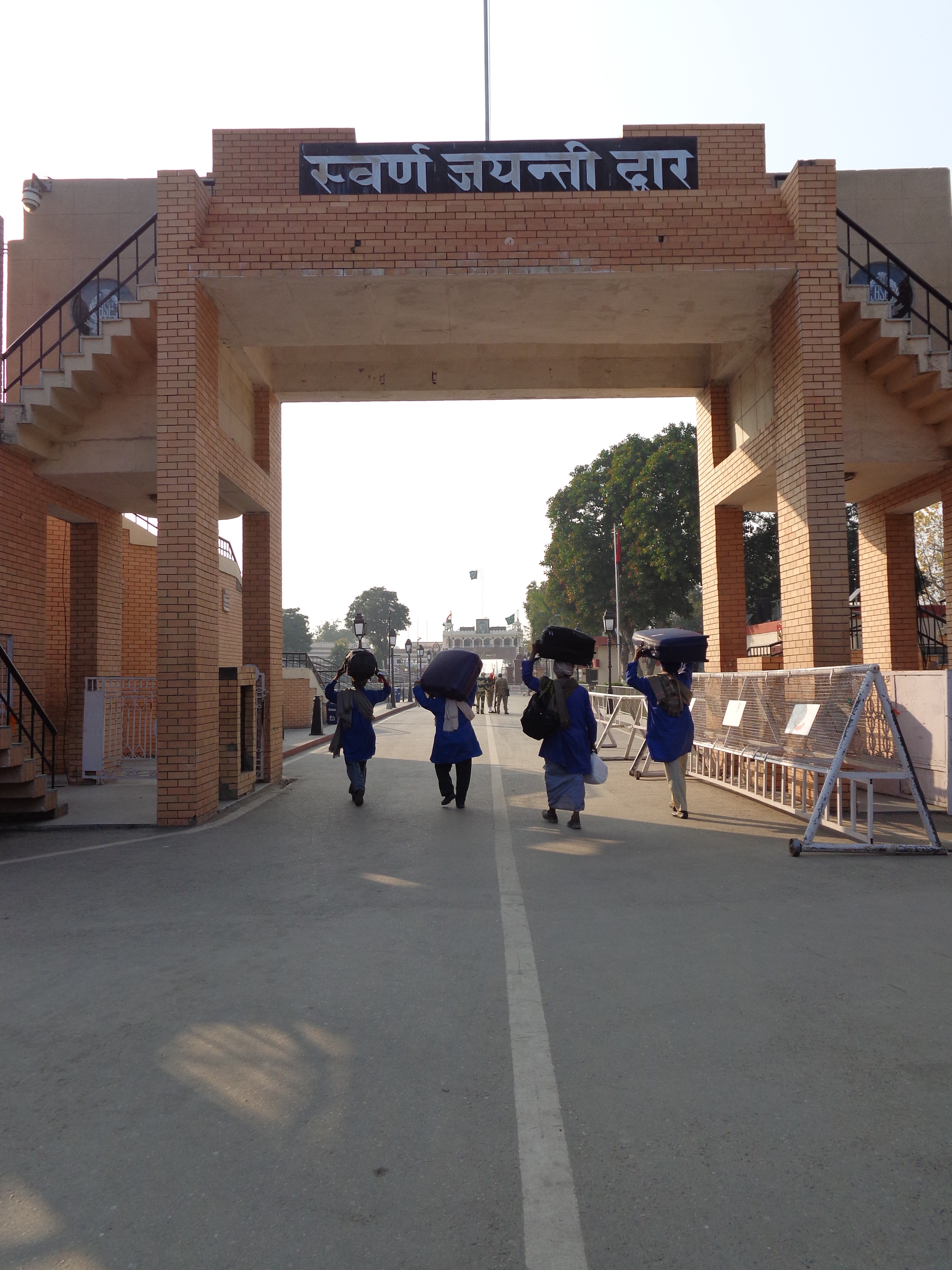 My family and I are one of the many victims of this man made border and this journey was a sad and bitter reminder. As my family stood in Amritsar to say good bye to us a few feet away my aunts, uncles and cousins stood to receive us. Siblings, cousins, nephews, and nieces, standing a stone throw away, estranged with tear filled eyes. Divided by a set of iron gates and a barrage of visa and requisite clearances.
The flurry of emotions I felt as I crossed these few feet I have never felt traveling across the world, crossing thousands of miles. As we moved forward to cross over, I remember thinking this was the most unnatural thing I have ever experienced. No act of God or Nature can create such an artificial divide between people, hearts and landscape.
We were one of the last passengers to cross the border. After the immigration counters close, and the gates are closed between the two countries, the Wagah border turns into a site for unabashed chauvinism The ceremony is a huge tourist attraction and slowly the stands on both sides filled up with thousands of people. We decided to stay on and watch the ceremony.
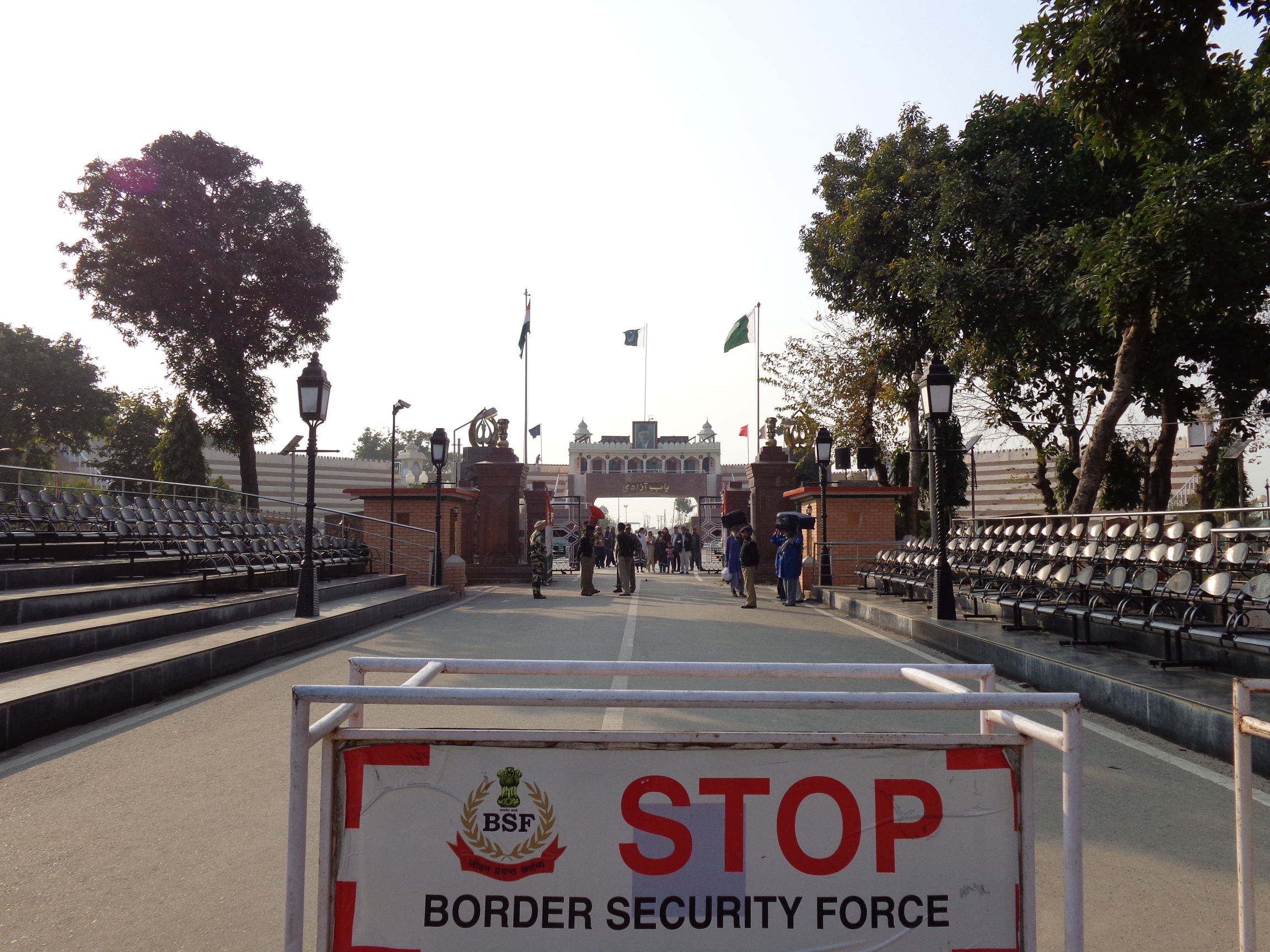 In a short while the calm silence was taken over with patriotic songs, blaring on loud speakers from each side. As we took our seats we could see distant glimpses of our loved ones sitting in the stands on the Indian side. Tall, uniformed Indian and Pakistani soldiers have been carrying out the choreographed routine of the border-closing ceremony since 1959. It is a full-fledged mass performance, played to a gallery of several thousand every evening. As Indian soldiers and Pakistani rangers compete in goose-stepping, a major domo on either side exhorts people to shout patriotic slogans.
Amidst the cheering crowds on both sides, there was a steady stream of tears in the eyes of a few. A few who can still feel the pain of this division, who still face the consequences of divided families, who still have loved ones on both sides, who are a sad reminder that this border was not God’s will nor an act of nature………but a man made tragedy.
The multitude of crowds that comes to see this border ceremony and refresh their patriotism have long forgotten the wounds and the legacy of the partition. They only see the continuing rhetoric of enmity, betrayal, and suspicion that the two countries rehearse against each other. The border closing ceremony at Wagah acts out the rhetoric of hate…….drowning all tears and voices of love.
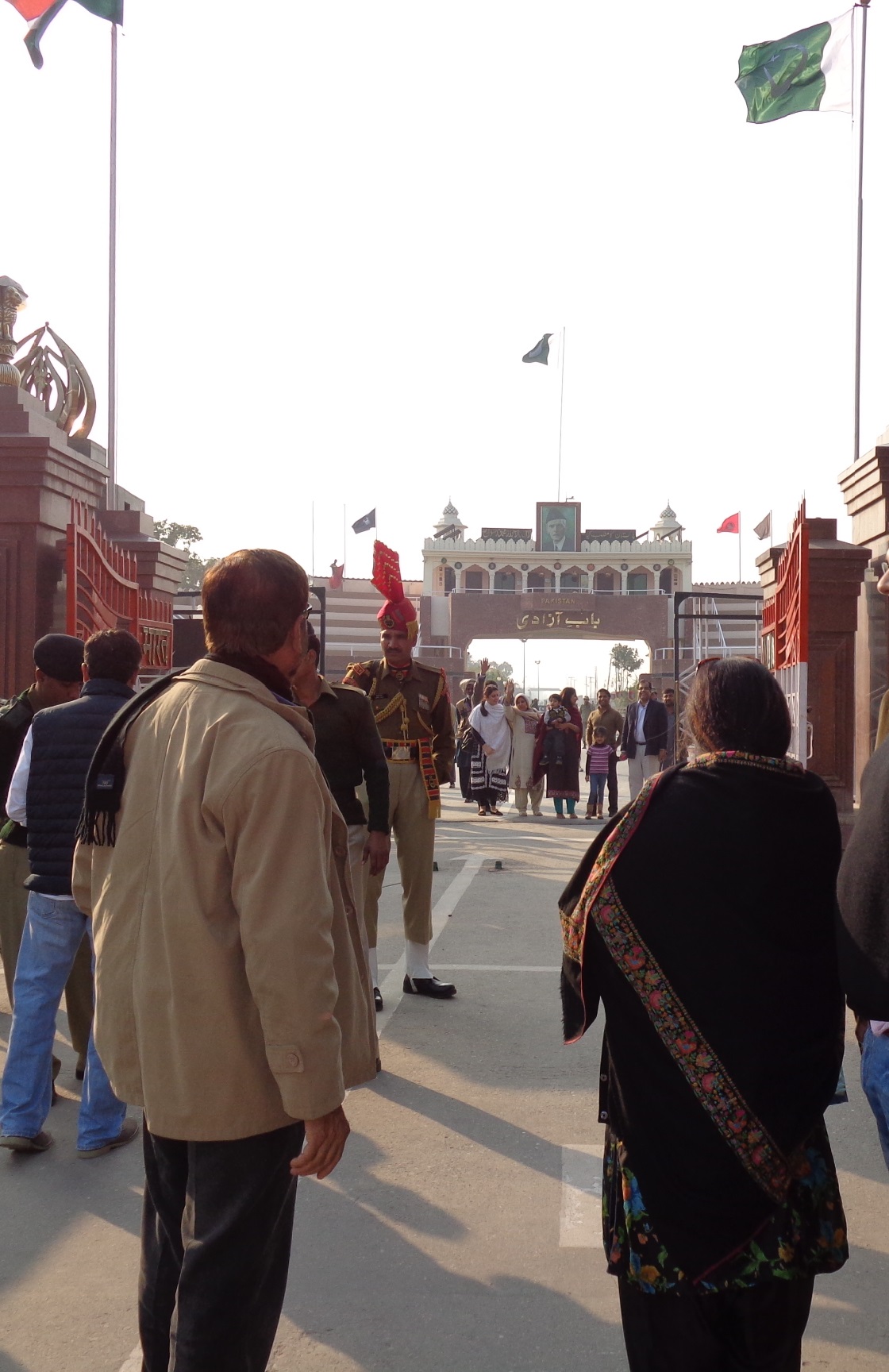 But soon…… there will be no teary eyes left in the stands, there will be no one to remember the tragedy that has been penned down, there will be no loved ones left across to catch glimpses of ….there will only be thousands of cheering crowds who will come to see a theater where India and Pakistan rehearse their chauvinistic hatred for each other.
I am an optimist, I do believe one day these gates will be open to all, there will be no penned border to divide us, but as we cross over there will no longer be a loved one eagerly waiting to hug us…….the generation and families that shared the pain of this division will no longer be there to witness the joy of unification. We would have finally crossed the line…….
All my life I have been an immigrant. I was born in India, grew up in Saudi Arabia, came to study in America, got married, started working and now have been living here for the last 16 years. But I often wonder……where do I belong.
How does one determine their belonging? Does it come from our ancestors, from geographic boundaries, from physical presence, from legal documentation or just from the heart….where one feels at home.
My husband and I love to travel and as we travel around the world, visit new places, and revisit places of our childhood, we realize that there is a part of us that resonates with every place we go to. It finds a commonality with the new cultures and people we encounter. It creates a momentary sense of belonging.
I remember reading somewhere that “Maybe your country is only a place you make up in your own mind. Something you dream about and sing about. Maybe it’s not a place on the map at all, but just a story full of people you meet and places you visit, full of books and films you’ve been to. ”
From our wanderings comes an understanding that home is really not a place on the map but a place in our mind…. May be it is just a nostalgic collection of memories, smells, people, feelings, and irrespective of where we are physically home will always be within us.
“Perhaps home is not a place but simply an irrevocable condition.”
― James Baldwin, Giovanni’s Room

The past is an interpretation. The future is an illusion. The world does not move through time as if it were a straight line, proceeding from the past to the future. Instead time moves through and within us, in endless spirals. Eternity does not mean infinite time, but simply timelessness. If you want to experience eternal illumination, put the past and the future out of your mind and remain within the present moment.
– The Forty Rules of Love by Elif Shafak
Yes I finally read the Forty Rules of Love, by Elif Shafak. The book was very thought provoking. It was a reaffirmation of many beliefs I hold true, it served as a reminder of the important things in life, and left the reader with a lot of food for thought. As I let the 40 rules marinate in my mind, I will regurgitate some of them as I process them.
To start with rule #28. We have all heard it before, live in the moment, the present is what is real and yet most of us drag the past with us as we pave the way for the future,and in the process create just a liveable present. Firm in the belief that the present will pass. Using carefully adorned reminiscences from the past and presumptuous optimism of the future, as our crutches for the present. Hoping that together they will help us carry the weight of the moment.
But why are we always trying to pass the present, even though it is the only real moment we have. We are so comfortable bearing hardships in the present only to create a picturesque future. Why do we want the certainty of hardships today in exchange for the possibility of hardships in the future?
No where can this mindset be more evident than in immigrants. They sacrifice their present in hope for a better future. Spending day after day, some home sick, some lonely, some angry, some bitter, but all hopeful that the future will be better. Losing count of when the future rolled into the present and also passed.
What is a better future? And can a better future really exist without a beautiful present? Is the future not just an extension or trajectory of our present and the past an account of it, both deeply entrenched and sourced by the present moment. If only we could live life in the present, if we could manage all our relationships without a past history nor a future expectation, we would be ensuring a better future and a beautiful past. May be that is what hell and heaven really are ………a real moment.
 Musings Of A Free Soul